
Mandatory invoice details in the Netherlands: what really needs to be on your invoice?
An invoice without the correct information can be rejected by the Tax Authority — and your customer won't get their VAT back. These are the 11 mandatory fields according to the VAT Act.
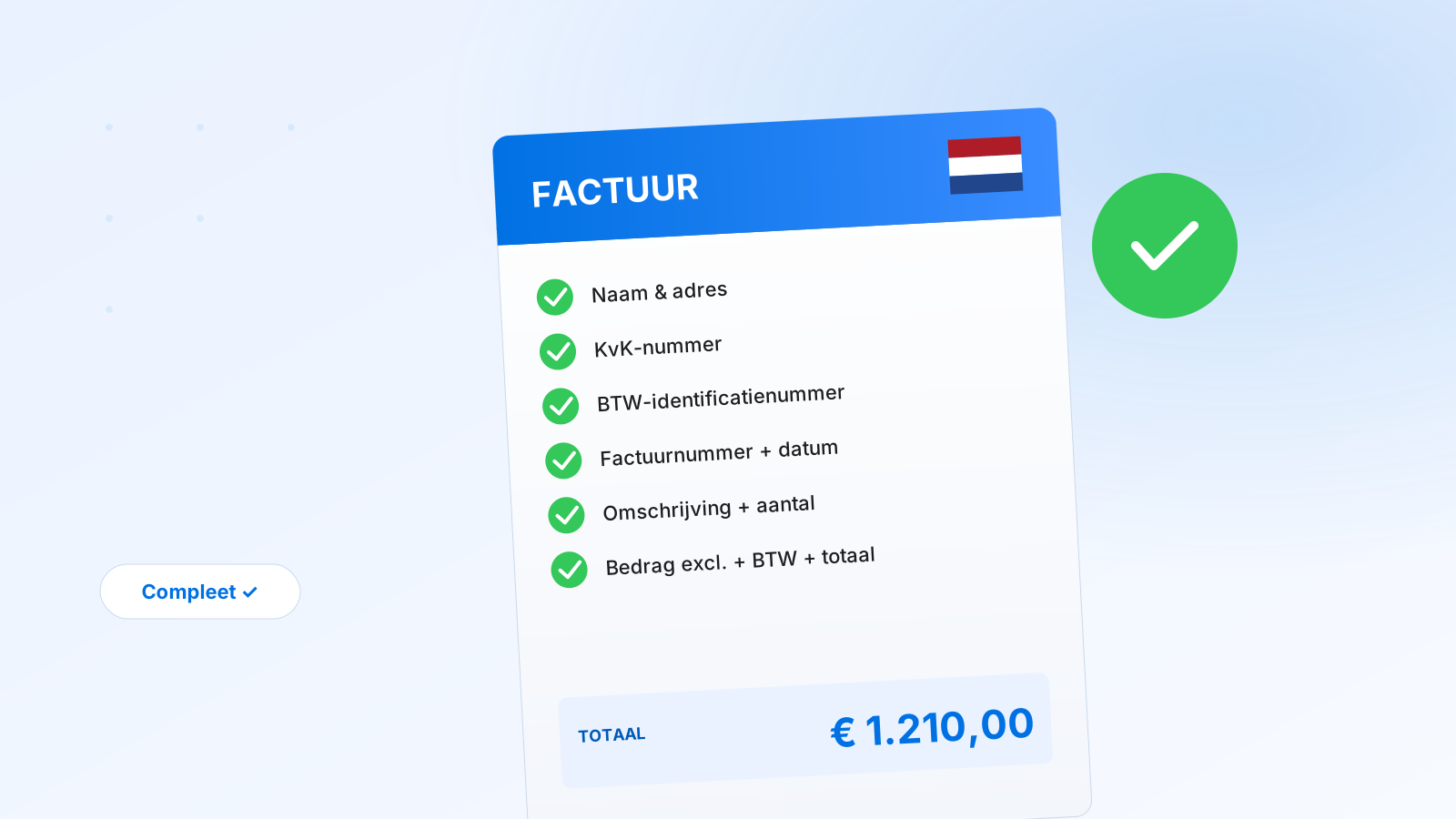
A professional invoice is more than just good design. The Tax Authority requires 11 legally mandatory fields on every invoice you send. If even one is missing, your customer cannot reclaim their VAT — and if you're audited, you risk a correction or penalty yourself.
The 11 mandatory fields according to the VAT Act
Article 35a of the VAT Act (Wet op de Omzetbelasting) specifies exactly what must appear on every invoice:
- Invoice date — the date on which you create the invoice.
- Sequential number — a unique, continuous invoice number (without gaps).
- Your business name and address — exactly as registered with the KvK (Dutch Chamber of Commerce).
- VAT identification number — must be clearly visible on the invoice.
- KvK number — include this as well (mandatory under the Trade Register Act).
- Name and address of your customer — no P.O. box, even for business customers.
- Description of goods or services supplied — clear and specific.
- Quantity or amount — for example, hours, units, kilometers.
- Date of delivery or service — may differ from invoice date.
- Amount excluding VAT, VAT rate, VAT amount and total including VAT — itemized per VAT rate if you use multiple rates.
- VAT reverse charge — mention this if VAT has been reverse charged (for example, with EU customers with a valid VAT number).
The 5 most common mistakes
From our experience with hundreds of entrepreneurs, we see the same mistakes recurring:
- Invoice numbers with gaps. Not 2026-001 followed by 2026-005. Continuous, no jumps.
- Vague descriptions. "Services January" is too general. Be specific: "Web design 12 hours at €75 — January 2026".
- No delivery date. With digital services you often use the invoice date, but with physical delivery the delivery date must be shown.
- VAT rate not stated. Even at 0% (reverse charged or exempt), the rate and amount must be shown.
- Wrong customer details. Check the KvK and VAT number of business customers — a typo can hold up an entire VAT return.
Simplified invoice — when is that allowed?
For invoices up to €100 (incl. VAT) and in retail, you can issue a simplified invoice. Then a number of fields are not mandatory. But note: for B2B invoices to entrepreneurs, the full invoice is required, regardless of amount.
How Invoisio handles this for you
We automatically fill in all 11 fields based on your business profile and customer details. Invoice numbers run continuously without gaps, VAT is automatically calculated per rate, and for EU customers with a valid VIES number, we automatically switch to reverse charge VAT with the correct notation.
Want to know if your current template meets all requirements? Try Invoisio free for 30 days and upload an existing invoice — you'll immediately see which fields are still missing.
Was this helpful?